
0105
The Strings
Eleven strings, tuned to a pentatonic scale and simulated as real ones: they can be swept, plucked and heard.
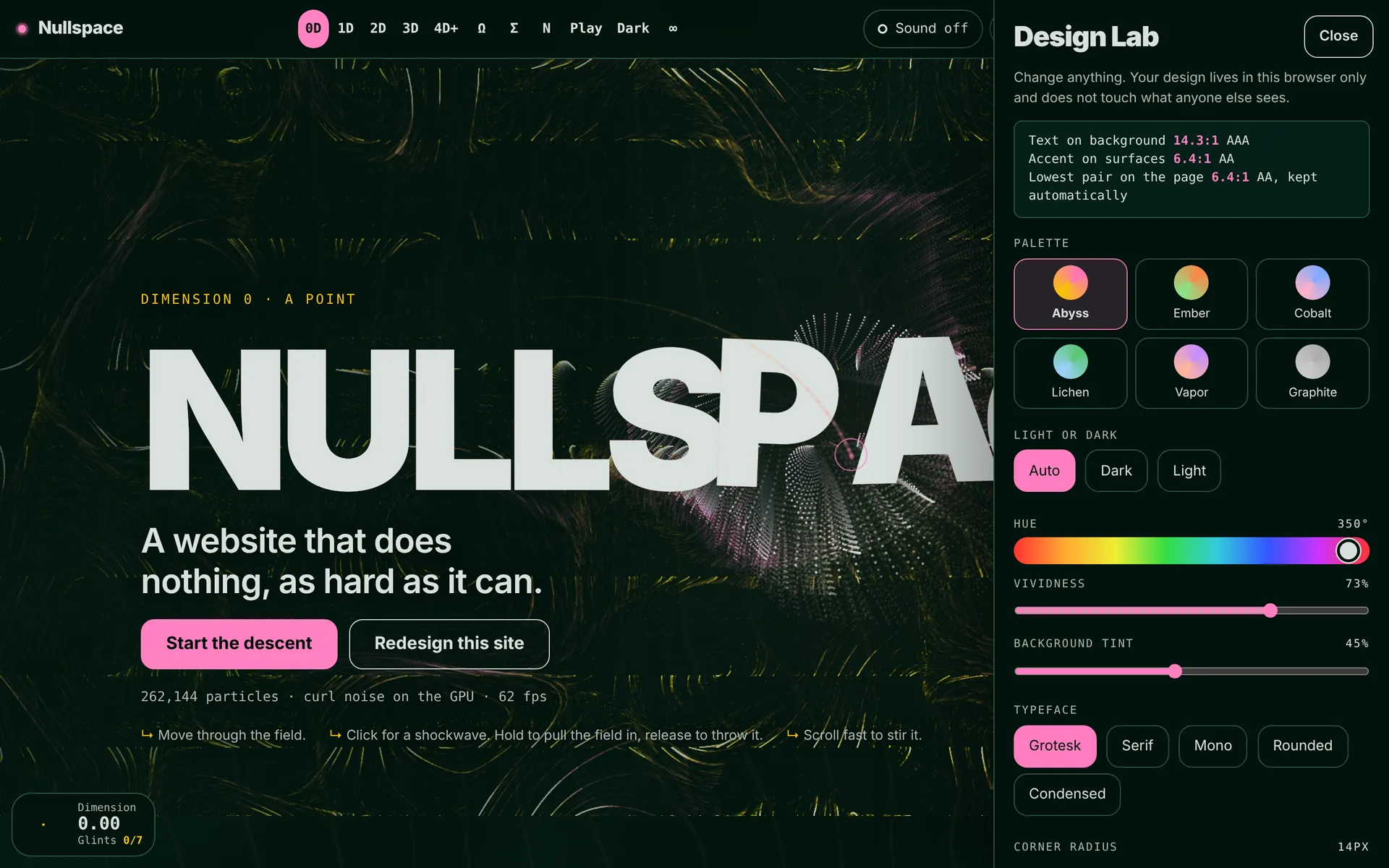
A website that does nothing, as hard as it can.
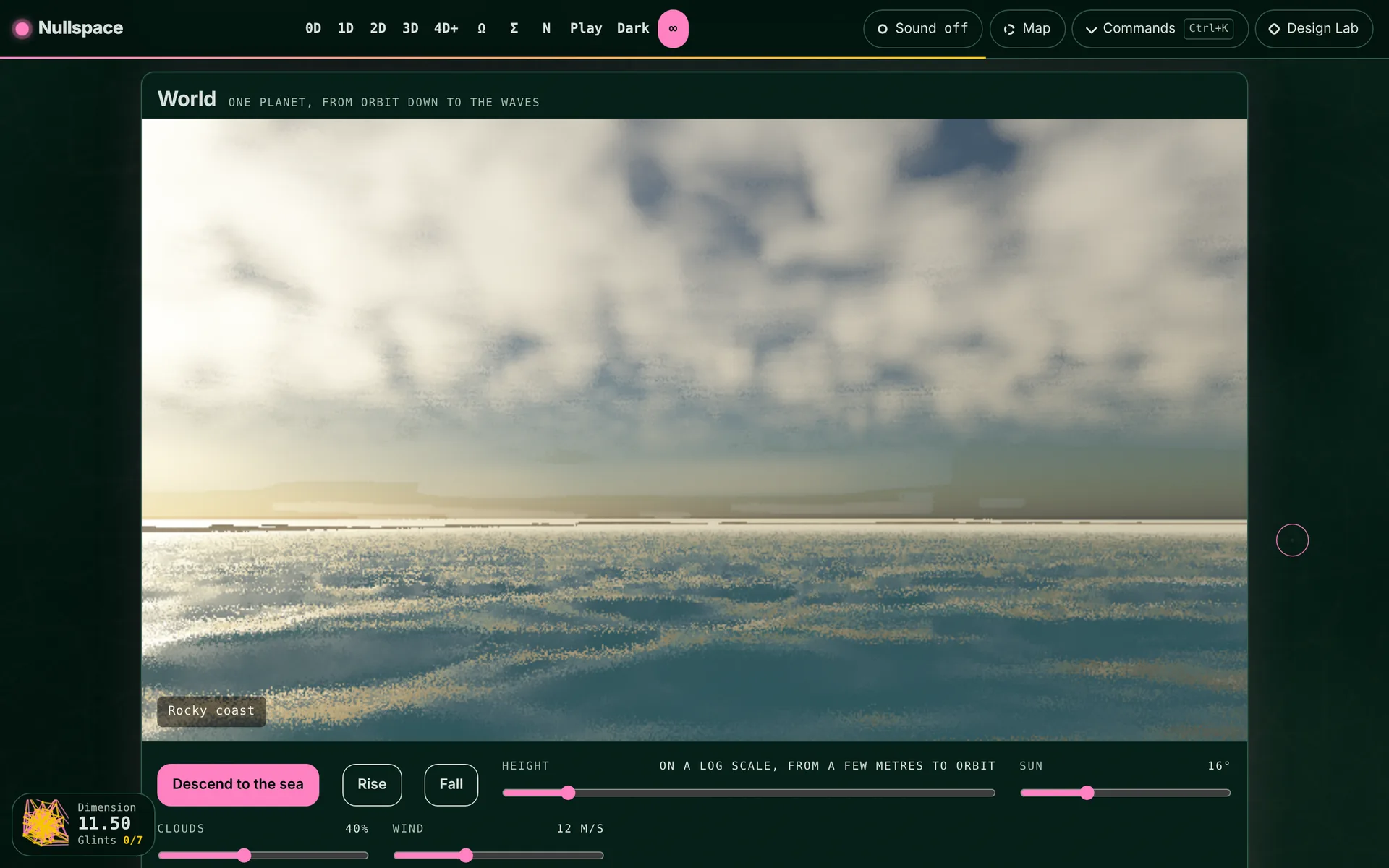
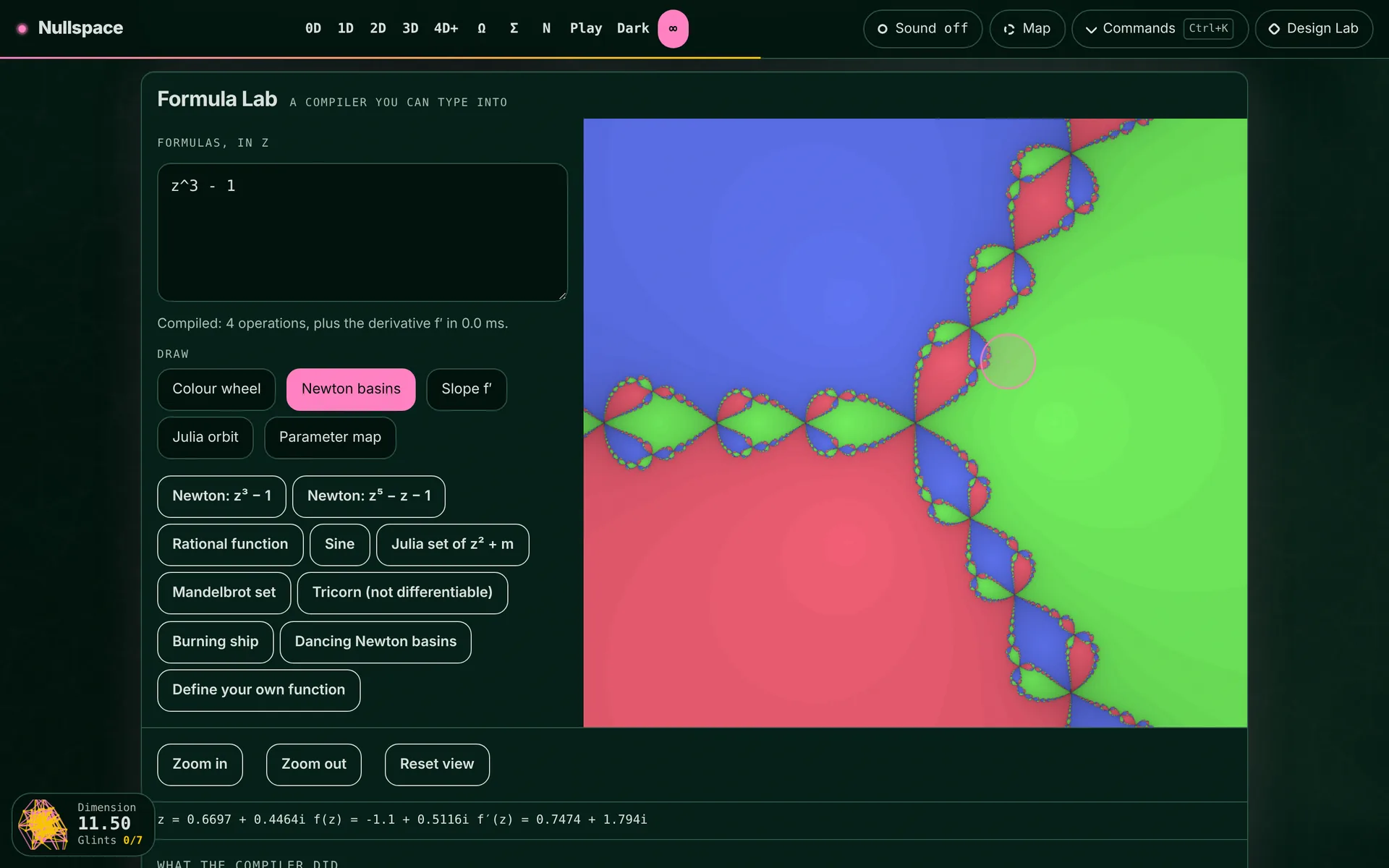
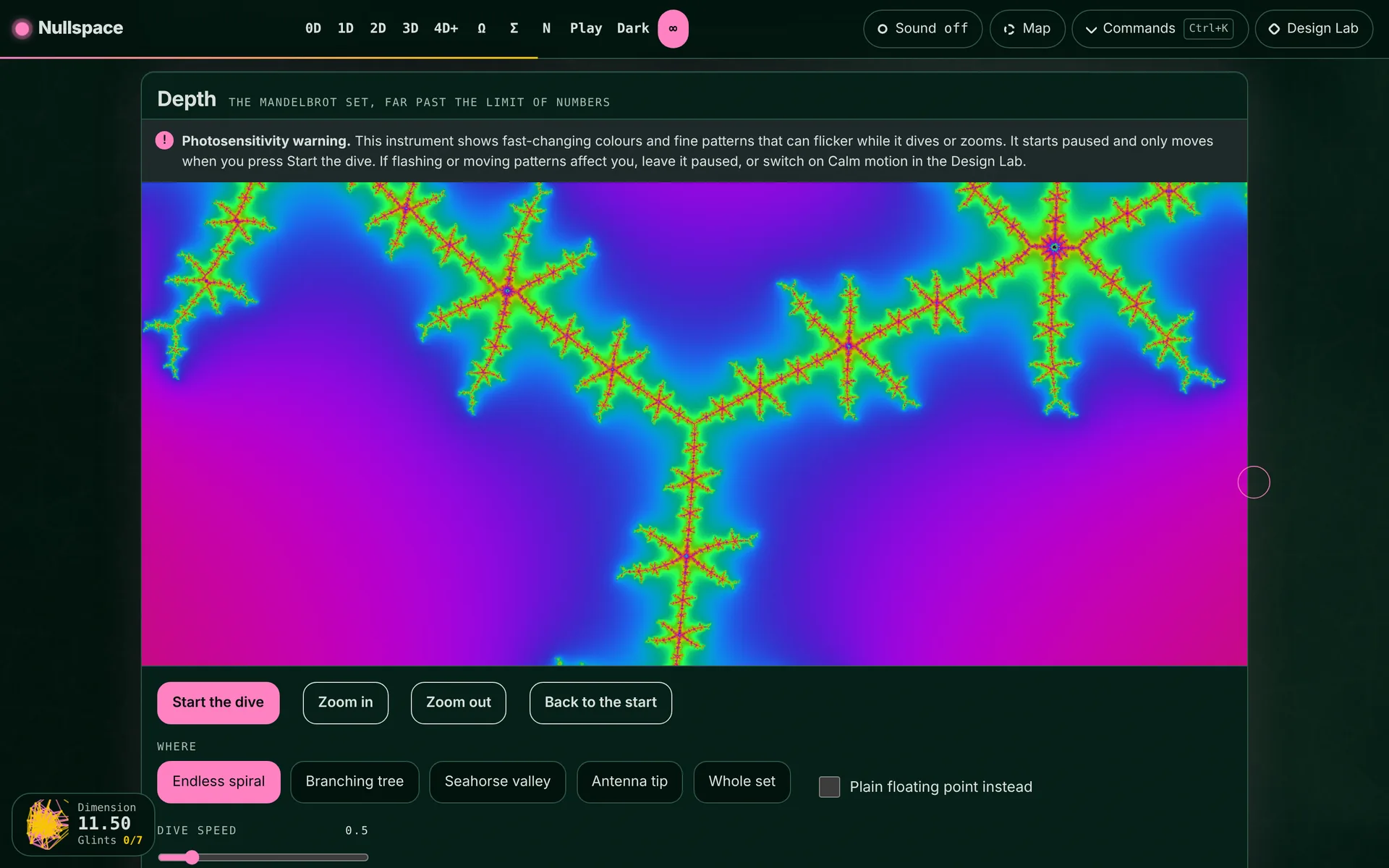
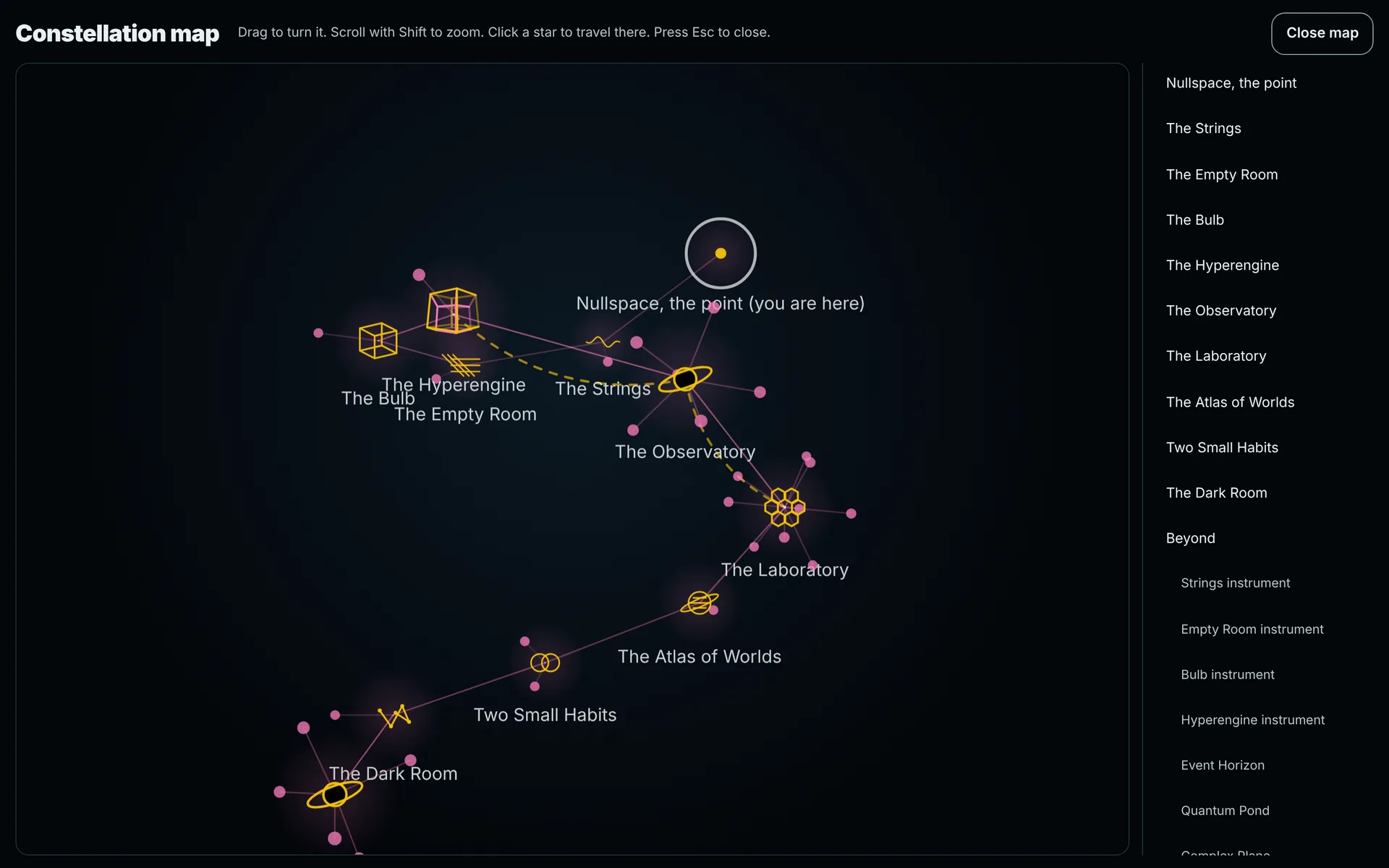
Eleven pages of maths and physics to play with, one room for each dimension: a particle field, strings to pluck, a 3D fractal, four-dimensional shapes, a black hole, a neural network that trains while it’s watched. Everything is drawn and sounded live in the browser.
Visit nullspace.aminrajbanshi.com (opens in a new tab)
Built with canvas, WebGL2 and WebAudio. No libraries, no web fonts, and no requests to other sites. Calm motion slows the animation, and the Design Lab keeps text colours readable at every setting. Eleven pages, including a formula compiler with symbolic differentiation, a live-trained neural network, a perturbation-theory Mandelbrot zoom, a Fourier-transform ocean and 62 powers of ten, backed by unit tests against independent calculations.
But what does that even mean?
It means that the website was built completely from scratch using only raw, built-in browser technologies. You may think “oh that’s pretty mundane…” but the more you delve into it the more you understand why this website is a badge of honour among web developers. It simply means the creator wrote pure, vanilla JavaScript without relying on any external code, frameworks, or assets.
Here is a breakdown in dot-points:
The Extreme: Finding a website built like this is extremely rare, probably fewer than 0.001% of active websites on the internet are built under these specific constraints. Modern web development relies heavily on frameworks (like React or Three.js) because they save time. Building a 3D environment in raw WebGL2 requires writing complex maths formulas (matrix maths, custom shaders) just to get a single triangle to render on the screen. Usually, a web creator just drops in a .PNG for an image or a .MP3 for a sound. Doing it with no network requests means they have to write code that mathematically synthesises audio frequencies (WebAudio) and procedurally generates textures out of maths equations. Developers who build hyper-optimised raw graphic demos are usually focused entirely on squeezing out performance. It is doubly rare for a developer to have both the maths skills required for vanilla WebGL, and the thorough awareness of digital accessibility required to properly build and test a prefers-reduced-motion override.
Nullspace is eleven pages: one room for each dimension, and a few that lie beyond them. What moves on them is not film. It is maths, run in the browser, frame after frame.
There are no libraries in it, no frameworks and no web fonts. The particles, the fractal, the four-dimensional shapes and the sound of the strings all come from code written for this site alone.
0105
Eleven strings, tuned to a pentatonic scale and simulated as real ones: they can be swept, plucked and heard.

0205
A three-dimensional fractal, ray-marched in real time and lit like an object that could be held.

0305
Four-dimensional shapes, up to the 120-cell with its 600 corners, projected into three dimensions and turned by hand.

0405
A black hole that bends light the way relativity says it should, seen from any angle.

0505
A small neural network trains in the browser on a picture, with sixteen of its neurons and its falling error drawn as it goes.
Designed and directed by Amin Rajbanshi, built in conversation with AI.